A Mini Trampoline is a compact rebounder designed for controlled, low-impact bouncing. It usually includes a circular steel frame, flexible springs or elastic bands, and a tightly stretched jumping mat. Unlike a full-size trampoline, it fits beside a sofa or in a small exercise room. That modest size can be misleading.
When a person presses down, the mat and suspension system store energy. They then push the body upward as the springs or bands return to their resting position. The frame provides stability, while the user’s ankles, knees, hips, and core help control each landing. The movement is simple. The technique is not always simple.
Albert E. Carter, an early rebounding exercise educator, wrote, “Rebounding is the most efficient, effective form of exercise yet devised by man.” This statement reflects enthusiasm, not a universal medical conclusion. A Mini Trampoline can support balance training, gentle aerobic movement, and enjoyable home workouts, but results depend on technique, duration, and personal health.
The surface should feel firm, not loose. Feet should remain close to the mat. Beginners often bounce too high, which reduces control and increases unnecessary impact. That mistake is easy to make.
This guide explains how the equipment works, what happens during each bounce, and why suspension design matters. It also considers practical limits, including frame stability, noise, user weight ratings, and safe progression. No fitness tool is perfect. A Mini Trampoline may feel playful, yet it still deserves careful setup and informed use. Faces, not hype, should guide expectations.
A mini trampoline is a compact rebounder designed for indoor bouncing. Most models have a circular frame, a flexible jumping mat, and springs or elastic cords. Their diameter commonly ranges from 36 to 48 inches, although sizes vary. The mat bends under body weight, stores mechanical energy, then pushes the user upward. This repeated movement creates a gentle rhythm rather than a high jump.
In practical use, the feet should stay near the mat’s center. A light bounce can raise the heels only a few inches. Deeper jumps demand more balance and leg control. The frame may feel stable, but it can still shift on smooth flooring. A clear area, secure footing, and gradual practice matter. The equipment is not automatically low-risk. Poor posture, fatigue, or overconfidence can cause falls.
A mini trampoline can support aerobic activity when used consistently. The World Health Organization recommends 150–300 minutes of moderate activity weekly for adults (WHO Guidelines on Physical Activity and Sedentary Behaviour, 2020). However, a rebounder session’s intensity depends on bounce height, pace, and fitness level. It should not be treated as a precise calorie-burning tool. The Centers for Disease Control and Prevention reported that only about one in four U.S. adults met both aerobic and muscle-strengthening guidelines in 2020. That figure makes simple home movement appealing, though I may be overstating its convenience if storage and supervision are ignored.
A mini trampoline, or rebounder, converts body weight into controlled vertical movement. Its main part is the jumping mat. The mat spreads force across its woven surface. Springs or elastic bungees connect the mat to the frame. When you land, they stretch and store energy. They then return that energy upward.
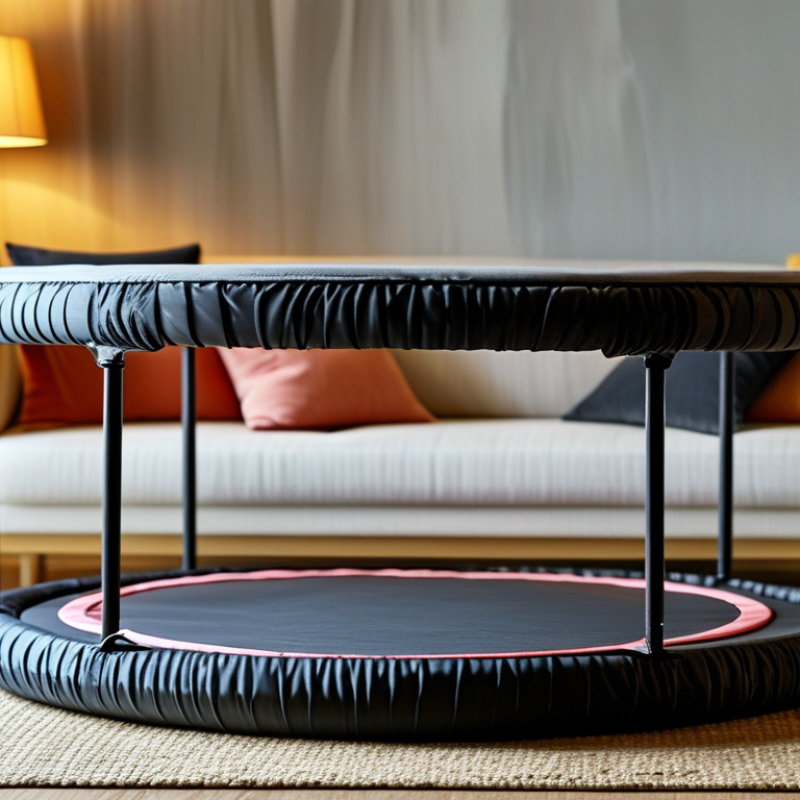
The circular frame provides structural support. Steel tubing is common, but thickness and weld quality matter. Short legs keep the rebounder stable on a level floor. Some models include rubber feet to reduce sliding and floor marks. A protective pad covers the frame and spring area. It should remain secure, without exposed gaps. A handlebar is optional, yet it can improve balance during slow exercises. It can also create a false sense of safety.
During a hands-on inspection, check every connection before using the equipment. Press the mat gently and listen for uneven spring noise. Look for torn fabric, stretched bungees, loose bolts, or bent tubing. The U.S. Consumer Product Safety Commission’s NEISS surveillance has reported more than 100,000 trampoline-related emergency-department visits in some recent annual estimates. That figure covers trampolines broadly, not only mini models. It still shows why component condition deserves attention. ASTM F381 also addresses safety requirements for toy trampolines, although fitness rebounders may follow different product specifications. A clean frame does not prove safe operation. Hidden wear is easy to miss.
A mini trampoline is a compact exercise frame with a flexible jumping mat. Metal springs connect the mat to the circular frame. When you step down, your body compresses the springs and stretches the mat slightly. The stored energy then pushes the mat upward again. This repeated movement creates a low-impact bouncing rhythm.
The trampoline works through controlled resistance, not simple jumping. Your legs produce force, while the springs absorb and return part of that force. Your ankles, knees, hips, and core adjust constantly to keep you centered. A gentle bounce may lift you only a few centimeters. A stronger bounce stores more energy and requires better control. The surface can feel forgiving, but it still places stress on joints when technique is poor. I have found that balance changes quickly when fatigue appears. That detail is easy to underestimate.
Tips: Check the frame, mat, and springs before each session. Stand near the center and begin with slow, shallow bounces. Keep your knees soft and your shoulders relaxed. Avoid twisting until your balance feels steady. Use a stable support bar only if it is properly installed. Follow the stated weight limit and exercise guidance. Stop if you feel pain, dizziness, or unusual joint pressure. A mini trampoline is not automatically safe for everyone. Surface quality, supervision, and personal health all matter.
A mini trampoline stores energy when the mat and springs flex downward, then releases that energy to push the user upward. The chart below shows an idealized vertical motion pattern during one rebound cycle.
How to read the chart: The mat starts near its neutral position, moves downward as the user lands, reaches maximum compression, and then rises as the springs release stored elastic energy. This is a simplified physics model; actual motion varies with body mass, jumping technique, spring tension, and mat flexibility.
During bouncing, the body repeatedly shifts between acceleration, brief weightlessness, and landing. The legs absorb force through the feet, ankles, knees, hips, and core. Unlike running on a hard surface, the trampoline mat and springs extend the landing time. This can reduce peak impact, but it does not remove impact completely. The American College of Sports Medicine identifies moderate exercise as roughly 3.0–5.9 metabolic equivalents, depending on effort and fitness. A gentle bounce may stay near the lower end, while deeper, faster jumps demand more oxygen and muscle work.
The heart rate usually rises as the quadriceps, calves, glutes, and abdominal muscles stabilize each landing. Blood vessels widen during exercise, helping deliver oxygen to working tissue. NASA biomechanics research published in the Journal of Applied Physiology found rebound exercise could create efficient cardiovascular and mechanical loading compared with treadmill exercise. That does not mean every bounce is automatically safer or better. Balance also matters. The inner ear senses vertical movement, while the eyes and joints help the brain control posture. I still find “low impact” an imperfect description. A tired jumper may land unevenly, especially when the surface is small. The 2021 ACSM exercise guidelines support gradual progression, controlled intensity, and recovery between sessions. Ten careful minutes may be more useful than twenty careless ones.
What Is a Mini Trampoline and How Does It Work?
A mini trampoline, often called a rebounder, is a compact exercise platform with a flexible jumping surface. Springs or elastic bands connect the surface to a circular frame. When you press down, the surface stores energy and pushes back. This creates a controlled bounce instead of a high jump. The movement can raise your heart rate while placing less impact on your joints than running on hard ground.
What Are Mini Trampolines Commonly Used For?
Mini trampolines are commonly used for home cardio workouts, warm-ups, and balance practice. Gentle bouncing may help improve coordination because your feet must respond to constant movement. Short intervals can also support endurance. For example, you might bounce for thirty seconds, march slowly, then repeat. Some people use rebounders during rehabilitation, but that should follow advice from a qualified healthcare professional. A mini trampoline is not automatically suitable for every knee, ankle, or back condition. It is easy to underestimate the effort. The bounce feels soft, yet tired legs can affect control quickly.
Tips: Place the trampoline on a level, uncluttered floor. Keep enough ceiling space above your head. Start with small movements and hold a stable support if needed. Check the frame and springs regularly. Stop if you feel pain, dizziness, or unusual pressure. The safest routine may look less impressive, but steady control matters more than jumping high.
| Data Dimension | Typical Information | How It Relates to Use |
|---|---|---|
| Definition | A mini trampoline, also called a rebounder, is a small trampoline designed primarily for individual use. | Its compact design makes it suitable for indoor exercise, home fitness areas, and supervised training sessions. |
| Typical Jumping Surface | Most mini trampolines have a circular jumping surface commonly measuring about 36 to fifty inches (91 to 127 cm) in diameter. | The smaller surface requires controlled, centered movements rather than the larger aerial maneuvers associated with full-size recreational trampolines. |
| Main Structural Parts | The basic structure includes a flexible jumping mat, elastic bands or metal springs, a frame, and supporting legs. Some models also include a stability handle. | Each component contributes to rebound, balance, weight distribution, and user support. |
| How It Works | When a person lands on the mat, their weight stretches the elastic bands or compresses the springs. The stored mechanical energy then helps propel the mat upward. | Repeated controlled landings and takeoffs create a low-height bouncing motion for aerobic and coordination exercises. |
| Rebound Height | Normal fitness bouncing is generally low to moderate in height and is intended to keep the movement controlled. | Low bouncing can reduce impact compared with repeated exercise on a hard surface, although it does not eliminate the risk of injury. |
| Primary Fitness Use | Mini trampolines are commonly used for low-impact cardiovascular exercise, warm-ups, interval routines, and general movement training. | Users can perform basic bounces, alternating steps, side-to-side movements, and controlled knee lifts. |
| Balance and Coordination | The flexible surface moves slightly under the user, requiring ongoing adjustments in posture and foot placement. | Regular supervised practice may help develop balance, body awareness, rhythm, and lower-body coordination. |
| Muscle Groups Involved | Commonly engaged areas include the calves, thighs, gluteal muscles, hips, abdominal muscles, and lower back stabilizers. | The exact muscle demand depends on the bounce height, exercise pattern, posture, and use of arm movements. |
| Home Exercise | Many people use mini trampolines for short indoor workouts because they require less floor space than many larger exercise machines. | They can be used for brief movement breaks, structured cardio sessions, or low-equipment home routines. |
| Rehabilitation and Gentle Movement | Some physical therapy and fitness professionals may incorporate a mini trampoline into selected balance or movement activities. | Suitability depends on the individual’s condition, stability, and professional guidance; it should not be treated as a universal rehabilitation device. |
| Space Requirements | A clear area should extend beyond the frame, with sufficient overhead clearance and a stable, level floor. | Keeping the surrounding area free of furniture, walls, and other obstacles helps reduce collision and falling hazards. |
| Handlebar Function | Some models have a front or center handlebar intended to provide an additional point of contact. | A handlebar may assist balance during beginner exercises, but it should not replace proper supervision or safe technique. |
| Common Users | Typical users include adults performing home workouts and older children using the equipment under close supervision. | User suitability depends on age, coordination, health status, equipment specifications, and the ability to follow safety instructions. |
| Weight Capacity | Weight limits vary by construction and should be checked in the equipment’s instructions. A general-purpose mini trampoline may support one user within its stated limit. | Exceeding the manufacturer-stated capacity can increase structural stress and the risk of equipment failure. |
| Safety Practices | Use one person at a time, bounce near the center, wear suitable footwear or follow the equipment guidance, and inspect the frame, mat, legs, and springs or bands regularly. | Controlled movement and routine inspection help reduce the likelihood of falls, collisions, and mechanical problems. |
| Important Limitations | Mini trampolines are not designed for unsupervised stunts, flips, wrestling, or multiple-person jumping. | Using the equipment beyond its intended purpose substantially increases the risk of falls and injury. |
: A mini trampoline is a compact rebounder for indoor bouncing. Most models include a circular frame, jumping mat, springs, and short legs. Its diameter often ranges from 36 to 48 inches. It creates gentle vertical movement.
Your body presses the mat downward. The springs or elastic cords store mechanical energy. They return that energy and lift the mat upward. The movement depends on bounce height, pace, and body control.
The main parts include the jumping mat, frame, springs, legs, and protective padding. Some models include rubber feet or a handlebar. Check for loose bolts, torn fabric, stretched cords, and bent tubing. A clean appearance does not prove safe condition.
Stand near the mat’s center. Begin with slow, shallow bounces. Keep your knees soft and your shoulders relaxed. Your heels may lift only a few inches. Small movements work.
It can support aerobic activity when used consistently. Exercise intensity changes with bounce height, rhythm, and personal fitness. It cannot provide a precise calorie estimate. Short sessions may feel easy, but fatigue can build quietly.
It may feel gentler than hard-surface jumping. However, poor posture, tired legs, or excessive bouncing can cause falls. Smooth flooring may also let the frame slide. It is not risk-free.
A properly installed handlebar may improve balance during slow exercises. It cannot replace good posture or careful foot placement. Holding it too tightly may create false confidence. That assumption deserves reconsideration.
Place the rebounder on a level, stable surface. Inspect the frame, mat, springs, padding, bolts, and feet. Listen for unusual spring sounds after gentle pressure. Follow the stated weight limit and exercise guidance. Stop after pain or dizziness.
A Mini Trampoline is a compact rebounder designed for indoor or outdoor bouncing, offering a convenient way to add gentle movement to daily life. Its main parts usually include a sturdy circular frame, flexible springs or elastic bands, a tightly woven jumping mat, protective padding, and supportive legs. Together, these components create a stable surface that responds smoothly when a person steps or jumps on it.
A Mini Trampoline works by converting downward force into upward movement. As the user lands, the springs or bands stretch and store energy, then release it to help lift the body again. During bouncing, the muscles of the legs, hips, abdomen, and back work to maintain balance, while the body repeatedly adjusts to changes in motion. Mini trampolines are commonly used for low-impact cardio, balance practice, coordination exercises, warm-ups, home fitness routines, and enjoyable recreational activity. Proper posture, controlled movements, and a safe surrounding area can help make bouncing more comfortable and effective.

Lingsha